|
|
|
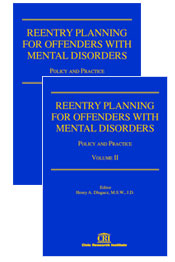
Reentry Planning for Offenders With Mental Disorders
Policy and Practice
Edited by Henry A. Dlugacz, M.S.W., J.D.
"Critical legal and policy issues, model approaches to re-entry planning, and research and practice."
—Research Book News
15% or more of U.S. inmates suffer a serious mental illness—once they’re released, what can we do to help them “make it” on the outside?
Mental illness doesn’t have to be a life sentence. Offenders with mental disabilities can be successfully re-engaged with their communities—when courts, corrections, probation, halfway and transition services, and mental health professionals work together. This important new book maps out a very specific set of strategies, responsibilities, program features, and guidelines that can guarantee a successful return to a productive life for offenders.
Now find help in designing and implementing effective reentry planning and aftercare specifically for offenders with mental disabilities …
Reentry Planning addresses and answers both the policy issues and practical programming questions confronting those who work directly with mentally disordered offenders …
- How much programming for the mentally disabled does the law now require? Are you better off doing the legal minimum or going the extra distance to provide first-rate services and programs?
- How can you take advantage of grants and other funding now available under the “Second Chance Act” to get the resources you need?
- What is the role of advocacy lawyers and judges in the re-integration of offenders? What sentencing strategies make the courts part of the solution, not part of the problem?
- What assessment tools are available and effective in tailoring a reentry plan for the mentally disabled offender? Why aren’t psychological assessments alone sufficient and what other types of instruments play an important and constructive purpose? Who should perform these assessments?
- What features does a comprehensive and effective continuity-of-treatment plan include? What are the specific aftercare responsibilities of counseling psychologists? Psychiatrists and physicians? Transitional services? Social workers? Probation officers?
- How can you ensure that a reentering offender is able to pay for treatment?
- How are co-occurring substance abuse problems best dealt with in a comprehensive re-entry plan?
Related Publications:
Correctional Mental Health Report
Management and Supervision of Jail Inmates With Mental Disorders, 2nd Edition
Managing Special Populations in Jails and Prisons
|
|
Table of Contents Vol. 1 (PDF)
Table of Contents Vol. 2 (PDF)
Volume I
Format: Hardcover Book
© MMX 375 pp.
ISBN: 978-1-887554-75-6<br>
Price: US $135.95
Product Code: RPOM1
Volume II
Format: Hardcover Book
© MMXV 352 pp.
ISBN: 978-1-887554-99-2
Price: US $135.95
Product Code: RPOM2
2-Volume Set
Price: US $237.50
Product Code: RPOM2VS
|