| |
|
| |||||||||||
|
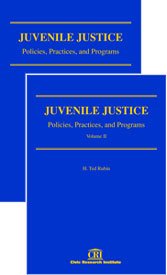
Juvenile Justice Policies, Practices, and Programs By H. Ted Rubin, J.D., M.S.W. “…exceptionally valuable insight into how systems can improve outcomes for the juveniles and communities they serve ... a ‘must own’ for everyone interested in juvenile court or services reform.” “Fascinating, current, and useful.” For over twenty years, Ted Rubin has sought out and studied juvenile programs throughout the country to find out exactly what works and what doesn’t work in getting troubled kids on the right track. Now Rubin takes you inside the best-run juvenile programs from Maine to Hawaii, providing an insightful analysis of strategies, practices, and policies that get results—and get funded. “Ted Rubin writes with grace, knowledge, and passion. These chapters reveal an informed enthusiasm for the juvenile court and wonderful insights on how to improve things.” “A comprehensive discussion of the most significant issues confronting juvenile justice which all practitioners would do well to read. This book will be valuable to juvenile courts and justice systems across the nation.” “Ted Rubin's Juvenile Justice: Policies, Practices, and Programs provides an extremely well-informed perspective and is a must read for those interested in juvenile justice and its practice. Rubin's experience as a social worker, a lawyer, a state legislator, a judge, a trainer, and an evaluator of hundreds of juvenile courts and justice agencies has given him a unique viewpoint that will benefit anyone in this challenging field.” You’ll discover:
H. Ted Rubin, J.D. M.S.W., is a private consultant to juvenile/family court and justice agencies. His clients include state and local court systems, national and state juvenile delinquency agencies, legal organizations seeking to improve court handling of child abuse and neglect proceedings, foundations, and national court and Native American organizations. Mr. Rubin was Judge of the Denver Juvenile Court from 1965-1971. From 1971 until 1992, he was Director for Juvenile/Criminal Justice and then Senior Staff Attorney for the Institute for Court Management (ICM) of the National Center for State Courts, Denver. He was a principal in the national Restitution Education, Specialized Training, and Technical Assistance Project (RESTTA) (1984-1992) and was honored in 1990 with the National Center for State Courts’ Award of Excellence. Ted was awarded the National Association of Probation Executives' Dan Richard Beto Award in 2013 for Distinguished and Honorable Service to the Probation Profession, and a Centennial Alumni Award in 2016 from the Mandel School of Applied Social Sciences, Case Western Reserve University. Related Publications:
|
Table of Contents Vol. 1 (PDF) Volume 2 2-Volume Set 
|
||||||||||
|
|||||||||||
|
To order, use the orderform or contact: All Topics | All Titles | Home | Order |
|||||||||||
| ©Civic Research Institute Privacy Statement |
|||||||||||